From Spreadsheets to GRC Automation: How Middle East Compliance Teams Are Cutting Audit Prep Time by 85%
Your team just spent three weeks preparing for an NCA ECC audit. Someone screenshotted IAM policies out of AWS Riyadh. Someone else exported six months of Okta logs into a shared drive folder nobody else can open. A third person cross-referenced 108 ECC-2 controls against a spreadsheet with four owners and no version history, while chasing department heads for policy sign-offs that came back as scanned PDFs. Then the auditor arrives and the spreadsheet is already out of date, because two of those access reviews were superseded the day after they were captured.
That is not a resourcing problem. It is a structural one, and it compounds every year. Middle East organizations now run 5-8 overlapping frameworks simultaneously, SAMA CSF, SOC 2, NCA ECC-2:2024, ISO 27001, KSA PDPL, UAE PDPL, PCI DSS, GDPR, each with its own control language and inspection rhythm. Nearly half of organizations still manage risk in spreadsheets (SimpleRisk). At that framework density, manual compliance stops being merely inefficient and becomes a compliance risk in itself.
Why Manual Compliance Programs Break Under Middle East Regulatory Scale
The problem is not that spreadsheets are bad; plenty of well-run programs started in one. It is that four failure modes compound past three concurrent frameworks, which describes almost every regulated organization in Saudi Arabia and the UAE today.
1. Spreadsheet proliferation across framework owners. SAMA CSF maturity scoring sits with one team, NCA ECC tracking with another, the PDPL data inventory with legal, and the ISO 27001 Statement of Applicability with whoever survived the last certification. Four artefacts, four owners, four update cycles, no reconciliation until audit week, at which point the same encryption control appears with three different implementation statuses.
2. Evidence goes stale the moment it is collected. A screenshot is a claim about one instant. SAMA CSF maturity Level 3 expects controls that are defined, implemented and demonstrably operating, not a capture from last quarter. Manual evidence is structurally incapable of proving continuity, precisely what the maturity model asks for.
3. Human error in cross-framework mapping. NCA ECC-2:2024 carries 108 controls across four domains (nca.gov.sa). Mapping those by hand against ISO 27001 Annex A and SAMA CSF domains creates an error surface measured in thousands of cell references, and one mislinked control can misrepresent an entire domain in a self-assessment, which is what regulators read first.
4. No unified risk view for the board. When the audit committee asks “are we compliant?”, the honest answer from a manual program is “we will know once we check six spreadsheets.” Legal and compliance leaders now rate business risk at 7.9/10, up 36% since Q1 2025 (Diligent GC Risk Index), and are asked that question more often.
None of this is unique to the region in kind, only in density, which is why SAMA compliance automation is a different problem from automating one US framework. The data agrees: 60% of companies report their GRC and finance systems completely siloed or only partially integrated (Diligent Transaction Readiness Report).
Failure mode | What it costs a Middle East compliance team |
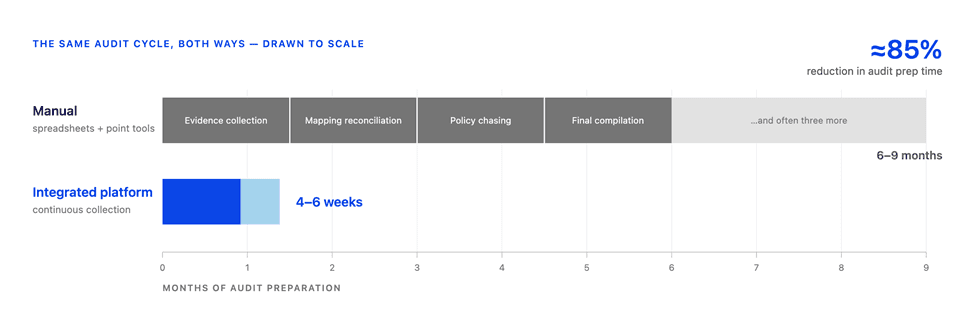
Spreadsheet proliferation across frameworks | 6-9 months per audit cycle vs. 4-6 weeks on an integrated platform |
Stale, point-in-time evidence | Risk of failing to demonstrate SAMA CSF Level 3 continuity |
Manual mapping of 108 NCA ECC-2 controls | Self-assessment errors that misstate a full ECC domain |
No aggregate risk view | Board and regulator questions answered on a quarterly lag |
What GRC Automation Actually Does: Tasks, Not Concepts
Compliance automation is software that performs compliance tasks without a human doing them by hand. For someone already running a program the useful question is narrower: which of the things my team does this week does it take over? Five categories, each with a concrete Middle East form.
Evidence collection: Read-only API integrations pull configurations, access logs, encryption states and endpoint posture from cloud infrastructure (AWS, Azure, GCP), identity providers (Okta, Entra ID), HR systems and dev tooling (GitHub, Jira). Instead of manually exporting NCA ECC-required audit logs from GCP Dammam each quarter, the platform ingests them continuously and maps them to ECC Domain 2 sub-controls.
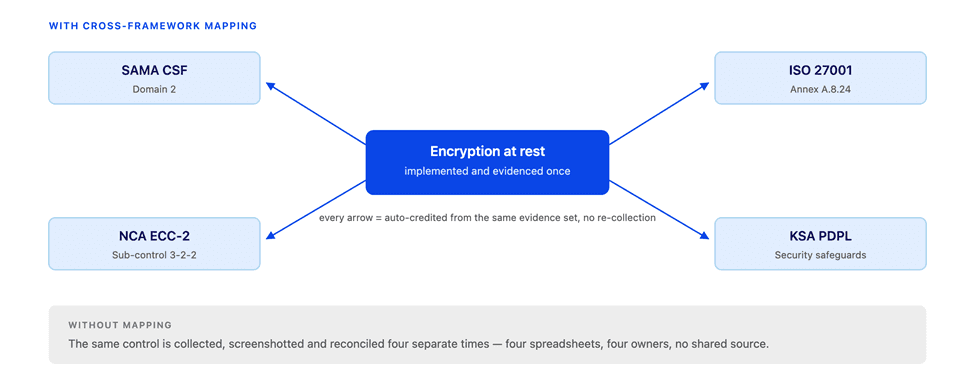
Cross-framework control mapping: One control, implemented once, credited everywhere it applies the highest-leverage capability for Middle East teams, because framework overlap here is unusually high. An encryption-at-rest control deployed for SAMA CSF Domain 2 is auto-credited against ISO 27001 A.8.24 and NCA ECC-2 3-2-2: same evidence, no re-collection, and no second spreadsheet.
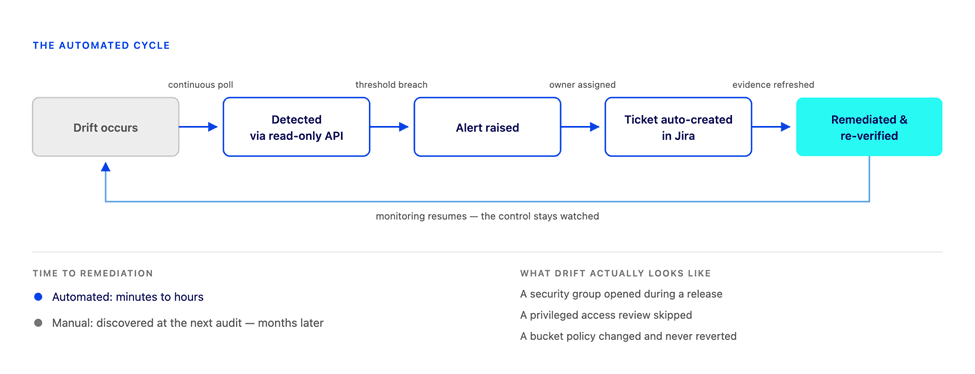
Continuous compliance monitoring: Controls drift, a security group opened, a privileged account review skipped, a bucket policy changed during a release. Continuous compliance monitoring catches that when it happens rather than at audit time. When an NCA ECC access control fails, the platform flags it and auto-creates a Jira remediation ticket within minutes, not at the next annual self-assessment. This is the part of NCA ECC GRC automation that changes findings into tickets.
Policy management and attestation: Version control, approval chains, distribution and per-employee acknowledgement with an immutable audit trail. KSA PDPL requires transparency artefacts in Arabic (sdaia.gov.sa); automated bilingual distribution routes both versions and records acknowledgement per employee, so the attestation record is itself the evidence.
Reporting and dashboards: Framework-specific, auditor-ready exports on demand plus a live posture view for leadership. Generate an NCA self-assessment export or a SAMA quarterly submission package in one click, rather than as a three-week manual compilation.
The compression is not marginal. The evidence work that consumes three weeks of a compliance team’s calendar before an audit takes roughly two hours on a properly integrated platform, most of it review, not collection.
Keeping It Real: Automation Is Not a Silver Bullet
At Vamu we’ll be the first ones to raise our hands to say that Automation is not the cure for everything. And also regardless of claims made by GRC Automation software, not every single thing can be automated and not all types of evidence can be captured in an automated manner. But yes 70% to 80% of the headache of mundane tasks can be taken care of by Automation Tools.
Beside this,what automation does not do is make judgement calls. Risk acceptance, control design, scoping and the reading of an ambiguous regulator expectation stay with your people; automation handles the data layer, humans handle analysis.
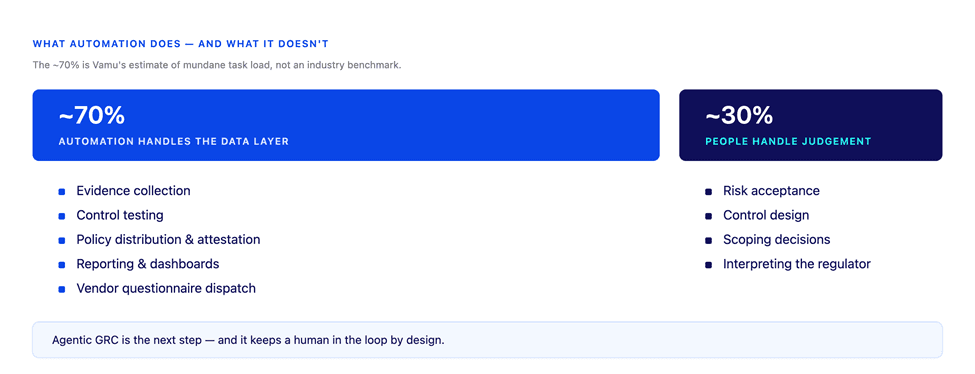
Where this goes next is agentic GRC: systems that surface likely audit findings rather than passively collecting evidence, and the teams with clean data pipelines today will be first to benefit. Whilst Vamu builds its AI Agentic eco system we move with a clear distinction that the process of Agents has to have a ‘human in the loop’.
Manual vs. Automated GRC: A Before-and-After for Middle East Compliance Teams
Abstractions do not survive contact with a compliance manager’s calendar. Below is the same set of tasks done both ways, with the consequence that matters in a Middle East context, and if you are building an internal business case, the table to put in front of your CFO.
Task / process | Manual approach (what most Middle East teams do now) | Automated GRC platform | Middle East-specific impact |
Evidence collection for a SAMA CSF audit | Screenshot AWS consoles, export Okta logs, chase IT for confirmations | Collected continuously through read-only integrations | Audit prep drops from ~9 months to ~4 weeks |
NCA ECC cross-framework mapping | Four separate spreadsheets, one per framework, reconciled by hand | One control, auto-mapped across every framework it satisfies | Eliminates roughly 60% of duplicated control work |
PDPL data inventory / ROPA | Spreadsheet refreshed quarterly, at best | Data map auto-updated from connected systems | Always audit-ready; no inventory lag behind reality |
Policy attestation (bilingual, KSA) | Email a PDF, track signatures in a side spreadsheet | Automated routing in Arabic and English with digital sign-off | Satisfies KSA PDPL Arabic transparency requirement with a provable record |
Control failure detection | Discovered at the next audit, months later | Real-time alert plus auto-generated remediation ticket | NCA non-conformity surfaced in hours, not quarters |
Board compliance reporting | Compile six spreadsheets each quarter | Live dashboard, board export in one click | Leadership sees posture across SAMA, NCA and PDPL at once |
Third-party and vendor risk | Questionnaires by email, 3–4 weeks to chase responses | Automated dispatch, scoring and reassessment cadence | SAMA CSF supplier risk requirement met continuously, not annually |
Audit trail integrity & KPI tracking | Version-controlled spreadsheets and manually compiled compliance KPIs; records can be overwritten or become outdated | Immutable, timestamped, verifiable records with automated KPI tracking and reporting | Supports SAMA CSF requirements for cybersecurity KPIs and measurement, with an auditable record of performance over time |
The ROI of GRC Automation: What Middle East Organizations Actually Gain
Six returns, each anchored to a number rather than an adjective.
1. Audit cycle compression: Global teams spend 9.5 hours/week on compliance-related work, roughly 11 working weeks a year; automation can save 3-5 hours/week (Vanta, 2025). An observed outcome, not a projection and the figure that moves budget conversations.
2. Recovered staff hours: Manual evidence collection against 108 NCA ECC-2 controls at a 50-person organization typically consumes an estimated 300–500 hours per audit cycle, a practitioner benchmark rather than a single named study, with automation cutting that by an estimated 60–80%. Multiply the midpoint by your loaded cost rate, the number is usually larger than the platform.
3. Eliminated control duplication: Organizations running SAMA + NCA + ISO 27001 + PDPL without cross-framework mapping implement and evidence the same controls three to four times over. Unified mapping removes that redundancy on day one, which is why regulatory compliance automation scales where headcount does not.
4. Real-time risk posture: A quarterly snapshot is out of date before it is presented. A live dashboard moves the board conversation from “we believe we are compliant” to a current, defensible position across every framework in scope.
5. Reduced penalty exposure: PDPL non-compliance carries fines of up to SAR 5 million and SDAIA enforcement is active (sdaia.gov.sa). A control failure caught and remediated in real time is a fundamentally different exposure profile from the same failure found by an inspector.
6. Transaction and investor readiness: For Middle East companies approaching a Series B, or enterprises entering due diligence with a sovereign fund or Aramco-scale counterparty, continuously maintained records compress diligence prep from weeks to days, which is exactly why the 60% siloed-systems finding sits in a transaction-readiness report.
The category is moving accordingly: $48.7B in 2023 to a forecast $179.5B by 2032, a 15% CAGR (Optro).
How to Move from Manual Compliance to a GRC Platform: A 7-Step Transition Framework
GRC platform implementation succeeds or fails on sequencing more than on product choice. Seven steps, each with a Middle East-specific action.
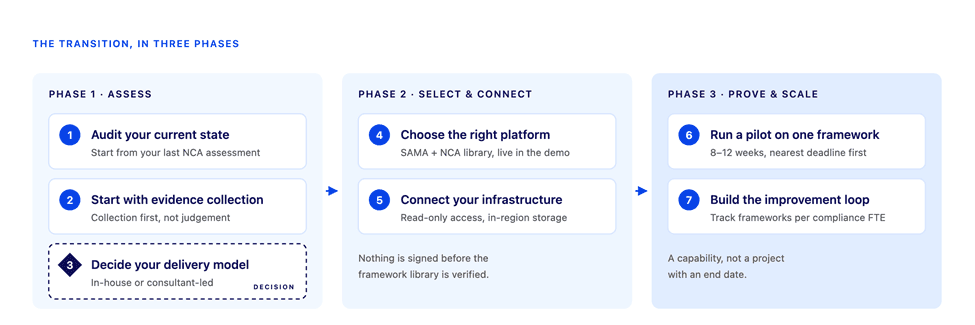
Step 1: Audit your current state - do not automate a broken process
Before evaluating any tool, inventory what you have: every framework in scope, every spreadsheet and point tool in use, who owns which controls, and where evidence lives. It is also important to analyze if you have the internal capacity to manage the task at hand.
Middle East action: pull your most recent NCA self-assessment or SAMA readiness report. Every control rated “partially implemented” is a process that needs defining before it can be automated, your implementation backlog, already prioritized by a regulator.
The one mistake that kills GRC automation projects: automating a process that was never fixed. An undefined process, automated, produces consistently wrong output faster than a human could. Fix the process, then automate it.
Step 2: Start with evidence collection - high volume, low judgement
Automate what is data-intensive, rule-based, recurring and consuming the most hours. That is almost always evidence collection, the highest-volume, most error-prone task in any program. Policy management and user access reviews come next.
What not to automate first: risk acceptance, control design and audit judgement. Compliance automation tools handle collection; your team handles interpretation.
Step 3: Decide your delivery model - in-house or consultant-led
Ask yourself the hard question. With all in hand and current responsibilities, is there a champion internally that can manage this, or is it best to outsource this to a consultant? You might need the help of a consultant to help you prepare due to current knowledge gaps and/or capacity, or due to some other commitments.
Step 4: Choose a platform built for your frameworks, not adapted to them
This is where Middle East organizations most often go wrong, selecting a US-centric tool, then spending two quarters manually building the SAMA CSF and NCA ECC control libraries that a Middle East-native compliance automation platform ships on day one. You pay for automation and do the framework engineering yourself.
Ask to see the framework library in the demo, not the sales deck. If SAMA and NCA control sets are not already present, maintained and versioned, the timeline you quoted is wrong. The checklist below is how to choose a GRC platform before signing anything.
Generally consultants have GRC automation tool partners but it’s always preferred to push for one. Don’t let them be the basis and incorporate the biases of their tools. You need to ensure you are looking at a tool that is for the Middle East with NATIVE build for the region.
Step 5: Connect your infrastructure and define data access
Connect every compliance-relevant system: cloud, identity, HR, security tooling, dev platforms. Scope permissions tightly, a GRC platform should hold read-only access for evidence collection and never write access to production.
Middle East data residency is non-negotiable: confirm evidence is stored in-region. NCA ECC and SAMA CSF expect compliance data for Saudi entities to remain in the Kingdom. A platform pulling your control evidence into an EU or US data center creates a fresh regulatory exposure while solving an old one.
Step 6: Run a pilot on one framework before scaling
Phased rollout is not a compromise; it is the correct method. Start with the framework carrying the nearest deadline or most frequent inspection; for Saudi organizations that is usually NCA ECC GRC automation or SAMA CSF. Validate three things before expanding: evidence collects reliably, controls map correctly, and audit exports match what the regulator expects.
Step 7: Build continuous improvement loops and measure ROI
Automation is a capability, not a project with an end date. Four metrics worth putting on a slide: audit prep time in weeks, control failure-to-remediation time in hours, percentage of controls passing over time, and frameworks covered per compliance FTE. That last one is how a compliance function stops being read as a cost center.
What Middle East Organizations Must Look For in a GRC Automation Platform
Run this list before you sign. Every item exists because a Middle East organization discovered it the expensive way, after procurement, and most GRC automation tools sold into this region clear only half of it.
☐ Native Middle East framework library. Pre-built, vendor-maintained control sets for SAMA CSF, NCA ECC-2:2024, KSA PDPL, UAE PDPL and ISO 27001, not templates you populate yourself.
☐ In-region data hosting. Compliance evidence stored in KSA or UAE regions, written into the contract, a sales team’s verbal assurance is not a data residency control, and relying on one may leave a gap against NCA’s residency expectations.
☐ Cross-framework control mapping. One control, automatically credited across every framework it satisfies. Without it you do the same work five times over and the platform is a filing cabinet with a subscription fee.
☐ Arabic-language support. Bilingual interface, bilingual policy management, Arabic audit output, KSA PDPL and NCA both assume Arabic artefacts, and retrofitting translation at audit time is how deadlines slip.
☐ Continuous evidence collection, not periodic imports. API-based read-only pulls updating in near real time. Compliance automation tools that rely on monthly CSV uploads are a spreadsheet with better branding.
☐ Built-in SAMA maturity scoring. Assessment aligned to the SAMA CSF maturity model, tracking progress toward Level 3 by domain instead of rebuilding the score by hand each quarter. This is the practical test of whether a vendor’s SAMA compliance automation is real.
☐ Third-party risk module. SAMA CSF explicitly requires supplier risk management, so automated vendor questionnaires, scoring and reassessment must be built in, not sold as a separate product.
☐ One-click audit-ready exports. NCA self-assessment output, SAMA quarterly submission packages and ISO 27001 Stage 1 / Stage 2 evidence bundles, in the format the recipient expects.
☐ MENA-based implementation support. An Arabic-speaking implementation team or regional partner network, a 24-hour turnaround from a US time zone desk during an inspection window is a risk you are choosing to accept.
Clear seven of nine and ask which two are on the roadmap, and when. Clear four and you are buying a project, not a regulatory compliance automation platform.
Common Obstacles When Transitioning to GRC Automation
These are predictable, and each has a known fix.
Leadership buy-in. Investment stalls because executives underestimate what manual compliance already costs. Fix it with arithmetic: staff hours per audit cycle × loaded cost rate, plus the 6–9 months to 4–6 weeks comparison. Frame it as capacity recovered, not software purchased.
Integration complexity. Legacy systems and non-standard tooling slow planning to a crawl if you try to solve everything at once. Start with the connectors covering the widest evidence surface, AWS, Okta or Entra ID, GitHub, Jira, and expand after go-live. Waiting for full coverage is how a 10-week pilot becomes a 10-month one.
Cultural resistance. People who have owned a compliance spreadsheet for four years hear “automation” as “your process was wrong.” Reframe it accurately: automation removes the worst parts of the job, not the job. “You will never take another AWS screenshot for an auditor” lands with every analyst who has done it.
Automating an inconsistent process. The most overlooked risk, and the reason Step 1 exists. Where control ownership is ambiguous or evidence standards vary by team, automation industrializes the inconsistency. Standardize first, then connect.
Frequently Asked Questions
What is compliance automation, and how does it differ from a GRC platform?
Compliance automation is software that handles specific tasks, evidence collection, control testing, policy attestation. A GRC platform is broader: it unifies governance, risk and compliance into one operating model with shared control data. Most modern platforms do both. For Middle East organizations running five or more frameworks, a unified compliance automation platform beats assembling point tools, because the value concentrates in the cross-framework mapping layer.
How long does GRC platform implementation take?
For a focused deployment covering one framework, ISO 27001 or SAMA CSF, a well-designed platform delivers value in 4–12 weeks. Enterprise-wide rollouts across multiple Middle East frameworks run 3–6 months in phases. The dominant variable is process readiness, not software: organizations with documented controls and clear ownership move far faster than those where ownership is still informal.
How does automation reduce compliance errors?
Manual compliance introduces error at two points: collection (wrong screenshot, stale export, missed control) and mapping (a control linked to the wrong requirement). Automated evidence arrives through read-only API integrations, so it is current and correctly attributed by construction. Mapping is pre-built and vendor-maintained, so one encryption control is credited correctly across SAMA CSF, NCA ECC, ISO 27001 and PDPL, removing the error surface rather than shrinking it.
What is the ROI of GRC automation for a Middle East organization?
KSA organizations managing SAMA CSF, NCA ECC and PDPL manually average 6–9 months per audit cycle versus 4–6 weeks on an integrated platform. For a three-person team that is hundreds of staff-days a year moved from evidence chasing to actual risk work, before counting avoided remediation costs and SDAIA penalties reaching SAR 5 million.
Do GRC platforms support SAMA CSF and NCA ECC simultaneously?
Purpose-built Middle East platforms do, and it is one of the most important evaluation criteria for Saudi organizations. Most global tools require you to build SAMA and NCA ECC control libraries yourself, then maintain them as both frameworks evolve independently. Middle East-native platforms ship both pre-mapped with cross-framework linkage, so evidence collected once satisfies both, the difference between running one program and two.