
Manual Evidence Hygiene: Advanced Frameworks for CISOs
The industry narrative is dominated by “continuous compliance” and “zero-touch auditing.” While this is the target state for any mature security program, the operational reality for most Chief Information Security Officers (CISOs) is messier. There is always a “last mile” of compliance; legacy on-premise systems, physical security logs, bespoke HR processes, and air-gapped backups that resists API integration.
Manual evidence collection isn’t going away, but the way we manage it is archaic.
For many organizations, manual evidence is the dark matter of their compliance universe: unobserved until it causes a problem. It lives in email threads, Slack DMs, and unstructured Sharepoint folders. It lacks the cryptographic certainty of a JSON log pulled directly from AWS CloudTrail.
To mitigate this risk, CISOs must stop treating manual evidence as an administrative task and start treating it as a governance discipline. This requires applying the same rigor to human-collected artifacts that we apply to automated telemetry: strict schemas, immutable storage, and rigorous chain of custody.
The Governance Gap in Human-Centric Controls
The failure mode in manual auditing is rarely the control itself; it is the provenance of the evidence. An auditor does not doubt that you performed a disaster recovery test. They doubt the screenshot of the Zoom call provided six months later with no metadata, no attendee list, and a filename like Screenshot 2024-03-12 at 10.45.png.
We need a shift in our mental model. Manual evidence is not a “file.” It is a data object that requires a wrapper of metadata to ensure its integrity over time.
The “Evidence Wrapper” Concept
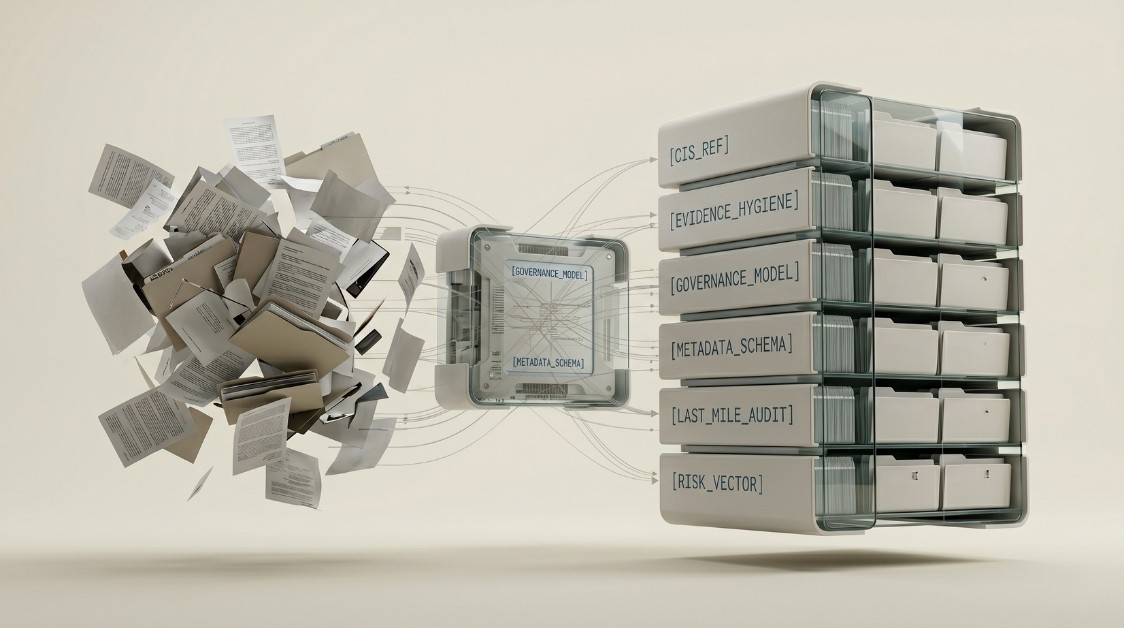
In a sophisticated governance model, no raw file should ever enter the compliance repository naked. It must be encapsulated in a metadata wrapper. This wrapper serves as a proxy for the API headers you would get from an automated system.
A robust manual evidence schema must enforce the following attributes before acceptance:
Temporal Validity: Does the timestamp of the artifact fall within the specific audit period window? (e.g., A penetration test report dated Jan 1st cannot evidence a control effective period starting Feb 1st).
Identity Attribution: Who captured this? Not just who uploaded it, but who generated the source data?
Contextual Linkage: Which specific control ID does this map to? “Access Reviews” is insufficient. It must map to
AC-04: Q3 Database Access Review.Integrity Hash: Once the human uploads the file, the system must hash it immediately. This establishes a “point of immutability.”
Strategic Action: Implement a “gatekeeper” workflow. Do not allow direct uploads to audit folders. Force all manual evidence through a ticketing system or a governance portal that enforces these metadata fields as mandatory inputs.
Operationalizing Semi-Automated Workflows
Since we cannot fully automate the collection of these edge-case artifacts, we must automate the governance surrounding them. This is the concept of “Human-in-the-Loop” (HITL) compliance.
The Ticket-Based Evidence Pipeline
The most effective way to sanitize manual evidence is to leverage your existing ITSM (IT Service Management) infrastructure.
Instead of emailing screenshots, engineer a specific Jira or ServiceNow issue type: Compliance Artifact Submission.
Trigger: The compliance calendar automatically generates a ticket assigned to the control owner (e.g., “Upload Q1 Firewall Rules Review”).
Constraint: The ticket workflow requires an attachment and specific field entries (Date of Review, Reviewer Name, Exception Count).
Validation: A script runs a basic heuristic check. Is there an attachment? Is the ticket status “Resolved”?
Ingestion: Once the ticket is closed, an automation hook (via Zapier, Workato, or native API) pulls the attachment and the ticket metadata into your system of record (e.g., Vanta, Drata, or a secure S3 bucket).
This transforms a chaotic human process into a structured, audit-logged pipeline. The “evidence” is no longer just the file; it is the file plus the ticket history, which proves who did what and when.
Taxonomy and Ontology Standards
Advanced hygiene requires a standardized naming convention that survives the human tendency to rename files. Your repository should not reflect the uploader’s naming habits.
Bad: Final_User_List_reviewed_ok.xlsx
Good: [Control-ID]_[YYYY-MM-DD]_[Artifact-Type]_[Hash].ext
By enforcing this taxonomy programmatically at the ingestion point (the semi-automated workflow described above), you ensure that an auditor can trace any file back to its control without opening it.
Measuring the Human Layer
You cannot optimize what you do not measure. Because manual evidence relies on human behavior, it is subject to fatigue, error, and procrastination.
CISOs need telemetry on the friction caused by these manual processes. Two critical metrics stand out:
Evidence Retrieval Time (ERT): The latency between a request for evidence and its successful, validated delivery. High ERT suggests process friction or lack of ownership.
Rejection Rate: The percentage of manual submissions that fail the “gatekeeper” check (e.g., wrong date, missing context) and are returned for rework.
Note: For a comprehensive breakdown of the specific metrics you should be tracking—and how to instrument them—refer to our dedicated guide on Top KPIs for CISOs.
Tracking these metrics allows you to identify which teams are struggling and which controls are imposing disproportionate operational tax on your engineering resources.
The Transition: Recognizing the Limits of Manual Scaling
While the frameworks above can stabilize manual evidence collection, they are fundamentally palliative measures. They manage the symptoms of manual work, but they do not cure the underlying inefficiency.
The trajectory of every mature security program is asymptotic toward automation. There is a tipping point where the “governance overhead” of managing manual evidence exceeds the cost of engineering an automated solution.
The Hidden Cost of Context Switching
The true cost of manual evidence is not the storage space or the compliance manager’s salary. It is the context switching forced upon your high-value engineers.
When a DevOps lead has to stop coding, log into a console, take a screenshot, blur out sensitive data, and upload it to a portal, the cost is measured in broken flow states and delayed product releases.
The Bridge to Automation
This is where the strategic value of modern Compliance Automation Platforms (CAPs) becomes undeniable. Tools like Vamu act as the architectural bridge. They are designed to ingest the 80% of evidence that can be automated via API, drastically reducing the surface area that requires human intervention.
For the remaining 20% - the unavoidable manual artifacts - these platforms provide the rigid “evidence wrapper” structure out of the box. They enforce the deadlines, send the reminders, and hash the uploads, effectively automating the management of manual tasks even if the tasks themselves remain human-centric.
Conclusion: Evidence is an Asset Class
For the modern CISO, evidence is a strategic asset class. It is the currency with which you buy trust from the market.
If your “trust currency” is counterfeit - smudged screenshots, questionable dates, broken chains of custody - your purchasing power in the enterprise market diminishes.
By applying rigorous governance models to manual evidence and aggressively transitioning to automation where feasible, you do more than pass an audit. You build a transparent, defensible security posture that serves the business rather than slowing it down.
Executive Next Steps
Audit Your “Orphans”: Identify every control currently evidenced by email or chat. These are your highest risk points.
Implement the Gatekeeper: Refuse to accept raw files. mandate a metadata wrapper or ticket-based submission for all manual proof.
Calculate the Tax: Estimate the engineering hours spent on manual collection annually. Use this figure to build the business case for broader automation.
Once you’ve built a compliance program that can consistently withstand audits, the next question becomes where it should take your business. If you’re planning to expand into enterprise or international markets, our guide Sequencing SOC 2 & ISO 27001 to Accelerate Global Enterprise Sales explains how to choose and sequence certifications without creating unnecessary work.